

It's-a me: Jumpman! In August 2026, Donkey Kong and the protoype Mario will appear together in LEGO® Super Mario™ 72051 Donkey Kong Arcade which recreates the game that introduced the world to these iconic characters for the first time. It's a playable game, to a degree – Jumpman is able to jump and move forward, but unable to climb.
How high can we get on its new elements?
We were given this product by The LEGO Group; the author's opinions are their own.
This article contains affiliate links to LEGO.com; we may get a small commission if you purchase.
72051 Donkey Kong Arcade
- Release date: 1 August 2026
- Pieces: 1367
- Ages: 18+
Price:
- US$ 199.99 on LEGO.com US
- CA$ 269.99 on LEGO.com Canada
- GB£ 149.99 on LEGO.com UK
- AU$ 279.99 on LEGO.com Australia
- NZ$ 299.99 on LEGO.com New Zealand
- 169,99€ on LEGO.com Deutschland, Nederland, France, etc
- PLN 729.99 on LEGO.com Polska
- NOK 2299,90 on LEGO.com Norge
- DKK 1399.95 on LEGO.com Danmark
Background
The original arcade
Donkey Kong is a groundbreaking arcade game released by Nintendo on 9 July 1981. The setup sounds simple by today’s standards: circus animal Donkey Kong has escaped and stolen Jumpman’s girlfriend Lady (later known as Pauline) away to a construction site. In a (for the time) impressive 4 stages, Jumpman needs to save his girlfriend. |
| Donkey Kong arcade at QuakeCon 2005, Texas. Attribution: Joshua Driggs (ZapWizard), CC BY-SA 2.0, via Wikimedia Commons. Modifications: cropped from the original and colours rebalanced. |

In the first stage, as Donkey Kong flings barrels down crooked girders, Jumpman needs to leap over them and climb ladders to reach Lady. This was inventive gameplay for the era, and this stage is also the most familiar to the general public – partly because the other levels were often omitted because of the hardware limitations of the home console ports of the time. It is no surprise that this stage is what the LEGO model is based on.
Later stages involve fireballs, conveyer belts, elevators, spring-weights and rivets. Both the characters Donkey Kong and Jumpman, renamed Mario would live on and have shown up in countless later games. A staple of Nintendo, the Donkey Kong game has been released in many versions to many platforms.
The original game came out a bit before my time, and while I don’t remember playing it myself, the gameplay is famous enough for me to instantly recognize the set.
Previous LEGO video games
LEGO® Icons has released several arcade games in recent years, but despite its iconic status, the game that introduced the world to Donkey Kong and Mario (known as Jumpman in this game) does not fall under the LEGO Icons umbrella, but instead its IP lands the set within the LEGO Super Mario theme.
Although this is the first arcade game for LEGO Super Mario, they have brought us other gaming systems: the handheld 72046 Game Boy and the television-bound 71374 Nintendo Entertainment System (see Ben's review of the retired LEGO NES set).
The LEGO Icons sets are 10323 PAC-MAN Arcade from 2023, and 11374 Arcade Pinball Machine which was released only 2 months ago (see Ben’s review of the LEGO pinball machine). Where PAC-MAN and the Pinball Machine boast over 2000 parts in their inventories, Donkey Kong makes do with 1367.
New mold: Tile Special 3 x 3 (8186)

- Tile Special 3 x 3 with Pixelated Jumpman print (6608464)

This is not the first pixelated LEGO version of Mario, as he also appeared while jumping and punching a block in 71374 Nintendo Entertainment System. Of that element (6326919 | 73210), graphic designer Anthony Palamaro mentioned it is the first LEGO part ever where the graphics were developed first and then the part designed to match. I can only assume this is the case here as well, as the part follows the shape of Jumpman.

The jagged surface measures nearly 3 x 3 modules with its height being half a plate shorter. In contrast with the earlier version, there is a black outline around the character.
The backside is similar to the other version as well, with an axle connector hidden inside a tube that can also function as an anti-stud.
Recolored elements

- 21x Fence Lattice 1 x 4 x 1 in Magenta (6629489 | 3633)

- 15x Barrel 2 x 2 x 2 in Orange (6629491 | 7792)

- 6x Barrel 2 x 2 x 2 in Dark Turquoise (6629487 | 7792)
- 1x Tile Round 2 x 2 with Bottom Stud Holder in Dark Turquoise (6629488 | 14769)
- 7x Ladder 1 x 4 in Dark Turquoise (6629490 | 7307)
More barrels, as well as the ‘Minecraft ladders’ and, to my surprise, the first teal appearance of the 2 x 2 round tile.

- 20x Tile Special Round 2 x 2 Inverted in Black (6593245 | 3567)
- 1x Tile 6 x 8 in Black (6614380 | 6320)

- 4x Brick Arch 1 x 5 x 3 1/3 Curved Top in Dark Azure (6632909 | 5845)
- 4x Plate 1 x 5 in Dark Azure (6609921 | 78329)
Decorated elements

- 15x Tile Round 2 x 2 with print in Tan (6608465)
- 6x Tile Round 2 x 2 with print in Dark Turquoise (6608466)

I am sorry to say that all other decorations are handled by decals instead of prints, including Donkey Kong, Lady and a Trouble Bug emerging from an Oil Drum.
Rare elements

- 1x 42610 Wheel 11 x 8 with Center Groove in White (6608797 | 42610)
- 4x 7212 Tile Round 6 x 6 in White (6528113 | 7212)
- 5x 5847 Brick Curved 1 x 2 Inverted with 1 x 1 Cutouts in Red (6585074 | 5847)
- 1x 7835 Slope 30° 1 x 4 x 2/3 in Red (6597352 | 7835)
- 4x 2456 Brick 2 x 6 in Dark Azure (6609906 | 44237)
- 10x 3003 Brick 2 x 2 in Dark Azure (6609904 | 3003)
The model

Similar to the other arcade games, this model packs in a great amount of functionality. The 3 controls at the bottom all function: on the left is a barrel on a lever that activates the barrel lift; the center lever moves Jumpman left and right; and the bright light orange button on the right makes Jumpman jump. He is, however, limited to remaining on one girder as he cannot climb the ladders.

The build of the arcade itself is fairly straightforward: as the model grows in height, girders are added, along with stairs that stay out of Jumpman’s reach. The Trouble Bug remains static.

The interesting stuff is found in the back. Using the lever in the front, the barrels are lifted one by one and then caught by the red LEGO® Technic connectors, pushing any barrels above it further up. When the first barrel reaches the top, it is pushed onto the girders and rolls all the way down. Note that the barrels are loaded facing the wrong way here, for the purposes of this photo.

In order to reach potential jams, both the lift mechanism and part of the ‘storage area’ are fitted with sliding doors. I did not encounter any jams while testing the set, but I also kept the model nice and level and steady, without shaking (too much).

There are 2 types of barrels: regular and blue. The blue barrels have extra weight added to them. The instructions don’t specify why this is, but I have a theory. In the game, the regular barrels skip the last 2 girders, leaving the screen to the side instead of dropping straight down to the girder below. The blue barrels however do roll all the way down, turning into a Trouble Bug when reaching the oil drum.

In the set, the barrels are guided along a wall during their drop to make sure they continue to roll. At the top of the last girder however, that wall is left open and a pin appears to select the direction of the barrel. I think the idea is that the heavier blue barrels fall more straight down and hit the pin such that they go left across the final girder, while the lighter barrels fly a bit further and make an exit to the right and reach the barrel lift rolling down a hidden slope. That is my theory at least, but in practice my barrels just seem to have a mind of their own and pick their route at random.

At the top, we find a stickered, static Donkey Kong and Lady, while Jumpman is mounted on an axle. As in the game, there are also two brick-built hammers to smash barrels for extra points. The barrels roll from the top of the barrel lift behind Donkey Kong onto the girder, as if the ape is throwing them.

Jumpman is connected to a mechanism in the back. The character itself is mounted onto a large black plate, which in turn is moved up/down and left/right by the controls on the arcade.

A closer look at the bracket holding the Technic axles reveals an Easter egg, as the colors represent the hat (red), face (light nougat) and overalls (blue) of Mario.

As a finishing touch, the name of the game is added in brick-built letters. Please, someone create a full alphabet!
Video of gameplay
The best way to describe all these functions is in a video.
Conclusion

The brick-built level is instantly recognizable, with the colors matching the original stage, but there are some differences compared to the online images I’ve checked. Of course, with the game coming in various versions, I could just have checked the wrong ones. There is no image of the level shown in the instruction manual.
The LEGO version only has 4 girders, while the game shows 6. The broken stairs are missing, as well as a second stair between Donkey Kong and Lady. The model is already pretty big, and adding the extra girders would make it harder to display and raise the price tag even further, while not really adding anything to the overall look.

Speaking of the price tag: the recommended price of €169.99/ US$199.99/ £149.99 for 1367 parts comes down to EU 12.4¢/ US 14.6¢/ GB 11p per part. That seems excessive, even by today’s standards. At least give us more printed decorations?
In comparison, the licensed PAC-MAN Arcade is just over EU 10¢ and introduces new molds, and the Arcade Pinball Machine sits at 9.2 cents (but has no IP license). So while the model is great, I just can’t recommend purchase without a hefty discount.
Pre-order now/ Buy from 1 August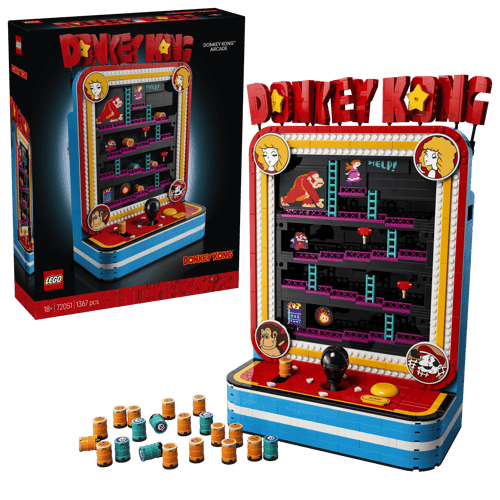
READ MORE: Also coming 1 August, the LEGO Jaguar E-Type
Help New Elementary keep publishing articles like this. Become a Patron!
A huge thank you to all our patrons for your support, especially our 'Vibrant Coral' tier: London AFOLs, Antonio Serra, Beyond the Brick, Huw Millington, Dave Schefcik, David and Breda Fennell, Gerald Lasser, Baixo LMmodels, Sue Ann Barber and Trevor Clark, Markus Rollbühler, Elspeth De Montes, Megan Lum, Andy Price, Chuck Hagenbuch, Jf, Wayne R. Tyler, Daniel Church, Lukas Kurth (StoneWars), Timo Luehnen, Chris Wight, Jonathan Breidert, Brick Owl, BrickCats, Erin and Dale, Jake Forbes, H.Y. Leung and our newest top-tier patron, Keith Marcelletti! You folks are better than inverted cheese slopes.
All text and images are ©2026 New Elementary unless otherwise attributed.
No comments:
Post a Comment