
LEGO® Education has been around for decades, but is often overlooked, primarily because these sets are not intended for the home, but for the classroom – often only available for purchase through specialist dealers who only accept teachers as their clientele. In a surprise move, The LEGO Group has released four sets specifically for children aged 7 to 9 in the wider market, grouped under LEGO Education At Home. Let's see what these sets can teach us.

Products in this article were gifted by The LEGO Group; the author's opinions are their own.
This article contains affiliate links to LEGO.com; we may get a small commission if you purchase.
Page contents
- Format of the sets
- 45200 Moon Mission Science Kit
- 45201 Antarctic Animals Science Kit
- 45202 Mars Mission Science Kit
- 45203 Arctic Animals Science Kit
- Video of all sets and conclusion
Format of the sets
The four sets are divided into two topics: the arctic and space. Each set consists of 2 or 4 sections, each with a "teachable moment". You follow the instructions to construct the section, in which the minifigure will run into trouble, which triggers you to Solve (red pages) and Invent (green pages).

The Solve entails a bag of parts that you use to solve the issue. With Invent, another bag of parts encourages you to invent something new; often an expansion on the build itself.
The concept feels familiar: back in 2022, LEGO® City released 3 City Missions sets where, after constructing a basic model, an app brings missions to solve (read my review of the LEGO City Missions concept). LEGO Education At Home already has a major leg up on these Missions sets: there is no app, or any other electronics and screens. Everything you need is found inside the box! The Missions sets were decent fun, but only focussed on being creative, while lacking true STEM lessons. I am hoping for more teachable moments in these new sets.
Many aspects of the Solve challenges can best be explained in moving pictures, so I have added a video to the end of this blog article.
45200 Moon Mission Science Kit
- Release date: 20 January 2026
- Age mark: 8+
- Pieces: 519
- Price: £44.99/ US$49.99/ 49,99€/ AU$79.99
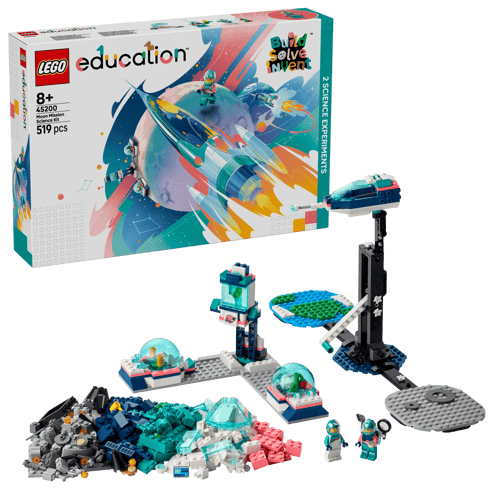
In this set, two astronauts lift off to the moon to build a lunar base. But the journey and their stay are not without obstacles... or new elements.
New elements

The astronauts wear a recolored neck bracket to attach equipment to:
- 1x Minifig Neckwear Front Harness with 4 Back Studs in Dark Blue (6595810 | 41811)

- 1x Windscreen 6 x 6 x 2 Canopy in Trans-Light Blue (6567039 | 35331) was introduced in January 2026, making the element borderline-new.
- 1x Windscreen 4 x 6 x 1 1/3 in Trans-Light Blue (6571048 | 5378)

There is no sticker sheet, and aside from the minifigures, there is only one new decorated element. I’m always happy to see new updates for the Classic Space logo.
- 2x Tile 2 x 2 with print in White (6583923 | 115545)

The figure on the left is wearing a recolored helmet and a newly printed torso:
- 2x Helmet Space, Dark Blue Neck Pattern in Dark Turquoise (6595808 | 49663)
- 1x Torso, Space Suit print in White (6595522 | 76382)
The figure on the right also comes with a new torso:
- 1x Torso, Space Suit in White (6595523 | 76382)
The model

The set is split in 2 sections, each with its own challenges. The first section is a rather neat contraption that launches the astronaut from earth to the moon. The Solve involves the landing: due to the weight distribution of the space craft, it tends to land on its nose. So using a bag of bricks, we need to find a way to make the craft land upright. This turns out to be rather easy: slap on enough bricks to shift the center of gravity to the back, and the craft neatly lands on its new feet.

The Invent portion is pretty simple: design a structure for the figure to live in.

After a successful landing, a base is set up, consisting of 2 greenhouse domes and a tower providing water and nutrients. The Solve here is to make sure these reach the domes. The easiest way is to build a slide for the tiles, as you can see in the video at the end.

The Invent asks for a kitchen to process the produce.
45201 Antarctic Animals Science Kit
- Release date: 20 January 2026
- Age mark: 7+
- Pieces: 461
- Price: £44.99/ US$49.99/ 49,99€/ AU$79.99
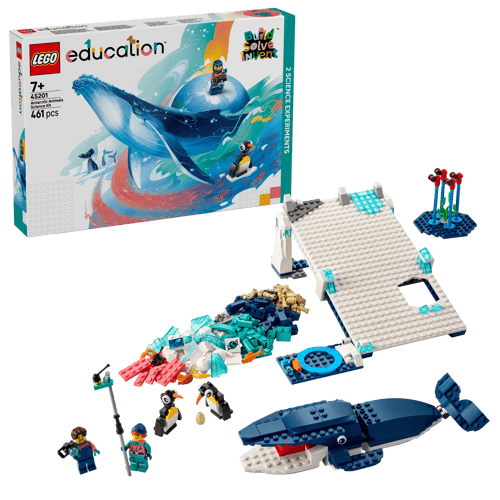
In this set, marine biologists are observing penguins and a blue whale... and new elements.
New elements

- 4x Axle Hose, Soft 7L in Blue (6597007 | 32580)
- 1x Wedge Plate 7 x 6 Boat Bow with Stud Notches in Dark Blue (6585258 | 50303)

- 2x Rock Panel 2 x 4 x 6 in White (6567045 | 54782)

There is no sticker sheet, and the only non-figure decoration reuses the Arctic symbol from the LEGO® City sub-theme.
- 1x Tile 2 x 2 with print in White (6583922 | 115544)

The only new element here is the torso worn by the figure on the left:
- 1x Torso in Vibrant Coral/ Coral (6595519 | 76382)
Frustratingly for monofig collectors: still no coral hands!
The model
The set is split in 2 sections, each with its own challenges.

The first section builds a large slide for penguins. But there is a large hole in the end, so for the Solve we need to guide the penguins towards the fish on the side, using various round bricks and slopes.

The biologist observing the penguins wants to have a go as well, so for the Invent we build a kayak, but I might have made it a tad too big to fit down the slope…

The second section builds a large blue whale, which is trying to eat some krill. The krill won’t stay in its mouth though, so the Solve asks for something in the form of teeth or another way to trap them.

The biologist is trying to get a tracker attached to the whale. In order to approach him, she needs a small boat built in the Invent phase.
45202 Mars Mission Science Kit
- Release date: 20 January 2026
- Age mark: 9+
- Pieces: 933
- Price: £89.99/ US$99.99/ 99,99€/ AU$149.99
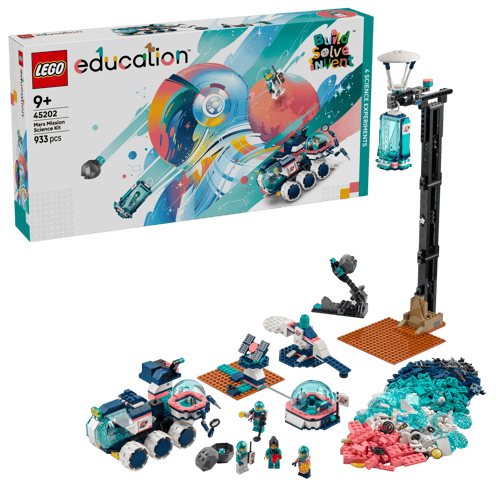
Moving on to the larger sets, set 45202 takes place on Mars. It comprises 4 sections, including some new elements.
New elements

This recolor is probably the most exciting one found across these sets!
- 14x Plate Special 2 x 2 with Bar Frame Round in Trans-Light Blue (6585259 | 7068)

- 2x Windscreen 6 x 6 x 2 Canopy in Trans-Light Blue (6567039 | 35331, 87606). Again, this one is on the cusp of being a new mold, as it first appeared in January 2026.

- 1x Plate 16 x 16 in Dark Orange (6567046 | 91405)

- 1x Minifig Neckwear Front Harness with 4 Back Studs in Dark Blue (6595810 | 41811), also found in 45200.

The only new decorated element is the same as found in 45200:
- 7x Tile 2 x 2 with Modern Classic Space Logo, Pink/Dark Red Planet print in White (6583923 | 115545)

The same new elements are found in these minigures as are found in set 45200.
- 3x Helmet Space, Dark Blue Neck Pattern in Dark Turquoise (6595808 | 49663)
- 1x Torso, Space Suit in White (6595523 | 76382)
- 2x Torso, Space Suit in White (6595522 | 76382)

Reviewing these space- and arctic-themed sets is making me nostalgic for Ice Planet 2000, so I need to mention these wheels, previously only seen in 71475 Mr. Oz's Space Car from 2024. We just need the return of trans-neon orange…
- 6x Wheel Hard Plastic, Treaded with 7 Pin Holes, Inner Ring (37mm D. x 22mm) in White (6587603 | 1148)
The model

The first section builds a gravity stimulator, but the balance is off! The Solve is very simple: just add some blocks to the other side. But in a twist, my daughter used an asymmetrical stack of bricks. When showing off her Solve to me, she rotated her stack so that the weight was further towards the center of the arm to create the correct counterbalance, as you will see in the video at the end. This was a great hands-on experience to explain the rules of physics within leverage.

The astronaut finds the seat to be too boring, so for the Invent we give her a spacecraft.

Landing an aircraft can be a rough ride, as demonstrated by this free-fall tower in section 2. To make sure the astronaut survives the landing, we need to add something to dampen the fall. We ended up using clip-and-bar connections to catch some of the energy, with whips sticking out of the button for additional cushioning in the Solve.

For the Invent, we build an additional craft bringing in food supplies, again making sure the craft lands safely.


In section 3, the base is set up. But the solar panel keeps getting hit by asteroids, so for the Solve we add an energy shield. Ours wasn’t too stable: it stopped the first asteroid, but did get damaged in the process.

The astronaut feels lonely out on Mars, so for the Invent we build him a communication tower to talk to his colleagues.
The final section is my favorite across all the sets, as it feels the most like a proper, standalone build rather than a quick way to get to the teachable moment.

The astronaut finds an asteroid and tries to transport it to the base. But the kicking mechanism on the side of the rover is too light to get it to move. For the Solve, we raise the mechanism and add a counterweight to give it more oomph.

Once the asteroid has reached the base, we Invent a way to cut it open and extract the crystal inside.
45203 Arctic Animals Science Kit
- Release date: 20 January 2026
- Age mark: 9+
- Pieces: 1134
- Price: £89.99/ US$99.99/ 99,99€/ AU$149.99
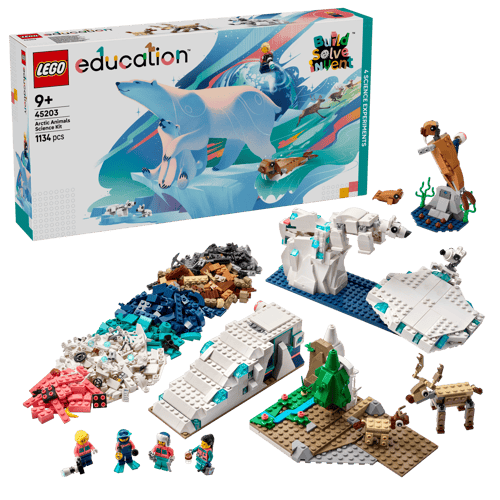
The final set is the largest of the group and takes place in the cold north. It gives us 4 sections and some hot new elements.
New elements

- 2x Plate Special 2 x 2 with Rubber Foot in Coral (6492701 | 109373)
This is the only set to contain a mold that is new to retail sets, as it has only appeared in other LEGO Education sets and was never available on Pick a Brick. This rubber foot is used to prevent a model from sliding on the table.

The underside is hollow. The curve is just too wide to hold a Dome Hemisphere 3 x 3 Ball Turret (44359, top image), but perfect for a Ball, Hard Plastic, 51mm (41250, bottom image).
Now on to the recoloured pieces:

- 1x Wedge Curved 6 x 4 Triple in Medium Nougat (6567041/6621859 | 8132)
- 2x Brick Special 1 x 1 with Studs on 2 Adjacent Sides in Medium Nougat (6567044 | 26604)
- 2x Brick Curved 1 x 2 x 1 with Curved Top in Medium Nougat (6595691 | 5841)

- 4x Rock Panel 2 x 4 x 6 in White (6567045 | 54782)

Again, no sticker sheet. The only new decoration is the Arctic symbol also found in 45201:
- 1x Tile 2 x 2 with print in White (6583922 | 115544)

The same new torsos from 45201 can be found in this set:
- 2x Torso Vibrant Coral/ Coral (6595520 | 76382)
- 1x Torso in Vibrant Coral/ Coral (6595519 | 76382)
Worth noting are the air tanks the diver is wearing. Minifig Neckwear Airtanks in Dark Turquoise (6550811 | 3838) has only been seen in 21358 Minifigure Vending Machine (read Kev's review of the LEGO gumball machine) and is popular with collectors of Castle and Classic Space figures.
The model

The first section is a snowed-in base. The Solve is to build a sled to get down the slope.

The Invent extends the sled in order to transport tools that are needed to dig out the base.

Section 2 creates a walrus and her child. The Solve requires the construction of arm to hold the infant. Riveting.

For the Invent, we construct a submarine that can collect poo for analysis. Okay, I wasn't expecting that.


The third section has a biologist studying deer. The display can switch from summer to winter by rotating the mountain; a very clever trick.

For the Solve, we add a winter coat to the deer. Not the most interesting challenge.

The deer keep running off, so we Invent a hideout for the biologist to study them in peace.

The final section involves polar bears on icebergs. The mommy bear keeps sliding off the plateau trying to reach her child, so we need to Solve this by adding claws to the paws.

The biologist faces the same issue, so we need to Invent a vehicle that gets traction on the ice as well.
Conclusion
Let’s see all the challenges in motion.
When I heard about these sets, I was enthusiastically hoping for LEGO® Technic-style sets exploring liftarms, structural integrity, gears and other engineering stuff. What we got instead feels much simpler, and to be honest, I was pretty bummed while unpacking the boxes: is this it? The challenges seem basic and simple, as do the builds involved.
Actually building the sets and trying out the challenges has shifted my opinion more toward the positive though, as there are some interesting problems to solve, especially in the Moon and Mars sets. Some are still not what I was looking for: adding a winter coat to a deer doesn’t feel like a challenge to me. But maybe I am looking too much from an adult engineering/technical standpoint: that particular section does discuss things like changing seasons, and how nature responds to it. So for young children (who are indeed the target audience here), it can still be a good teachable experience, just not in a field I am more interested in. As I mentioned, seemingly simple challenges like ‘balance a lever’ got me explaining some physics, so the sets are doing their job.
I suppose the added value comes for the most part from the parental figure: as the kid builds and engages in the challenges, it's the adult's task to provide the teaching. That being said, some background information for that adult to lead the conversation would be welcome, as that is missing in the package.
The Invent portion is also not too complex, but will get kids trying out their creativity. Some of the builds are simple, but there are also some clever tricks, like the release mechanism on the drop-tower.
I think that is the bottom-line: for AFOLs, there is not much to find here, both in new elements as well in builds and challenges. But for young children, these sets can be an interesting experience.
With an average of around 10c per part, the sets are a bit expensive as a part pack. I suspect the added lessons contribute to that higher price point, so hopefully the elements will show up on Pick a Brick, especially those rubber bricks.
 Set 45201 on LEGO.com
 Set 45202 on LEGO.com
 Set 45203 on LEGO.com
READ MORE: 21368 Peanuts – Snoopy's Doghouse is available to pre-order
Help New Elementary keep publishing articles like this. Become a Patron!
A huge thank you to all our patrons for your support, especially our 'Vibrant Coral' tier: London AFOLs, Antonio Serra, Beyond the Brick, Huw Millington, Dave Schefcik, David and Breda Fennell, Gerald Lasser, Baixo LMmodels, Sue Ann Barber and Trevor Clark, Markus Rollbühler, Elspeth De Montes, Megan Lum, Andy Price, Chuck Hagenbuch, Jf, Wayne R. Tyler, Daniel Church, Lukas Kurth (StoneWars), Timo Luehnen, Chris Wight, Jonathan Breidert, Brick Owl, BrickCats, Erin and Dale, Thunderdave, Jake Forbes, H.Y. Leung and our newest top-tier patron, Keith Marcelletti! You folks are better than inverted cheese slopes.
All text and images are ©2026 New Elementary unless otherwise attributed.
I wonder how intentionally Lego has marketed these to parents, by appealing to nostalgia for space/ice sets of their childhood, and the open play we remember from our childhoods.
ReplyDeleteThe wheels remind me too of my childhood, and there’s the obvious space logo that means little to children but a lot to adults.
It feels odd that the Rock Panel is new in white, but it shows there’s a lack of space and ice themes these days.
Hopefully these are a success and we see more
I don't think the space logo is any more of a nostalgia play here than it is in the many City space sets that have used it or variations of it. Same for arctic, which is basically in line with the City exploration sets save for the unique color scheme.
DeleteMostly I think the consistency is aimed at making kids not think of these educational sets as "lesser" than the rest of their collection—i.e. even after they do the problem solving "lessons" they'll still have a fun toy that works with all their other Lego.
That 2x2 rubber pad's round shape is fit with 2x2 round brick perfectly too.
ReplyDeleteIt also looks like one of the center tile pieces of a Rubik's cube.
DeleteAren't the Space logo tiles the exact same as the ones from 2024 City Space? I have both in front of me right now and there is no discernible difference.
ReplyDeleteIt's coral instead of (reddish?) orange in these sets
DeleteThank you! I had to take both pieces off their builds and hold them together, in a brightly lit room. Now I can see the shadow is darker on the new one. The coral I can barely distinguish from the reddish orange, but I think you are right.
DeleteI stand corrected!