We were given this product early by The LEGO Group; the author's opinions are their own.
This article contains affiliate links to LEGO.com; we may get a small commission if you purchase.
77985 Dinosaur Fossils: Triceratops
Price:
Other countries click here
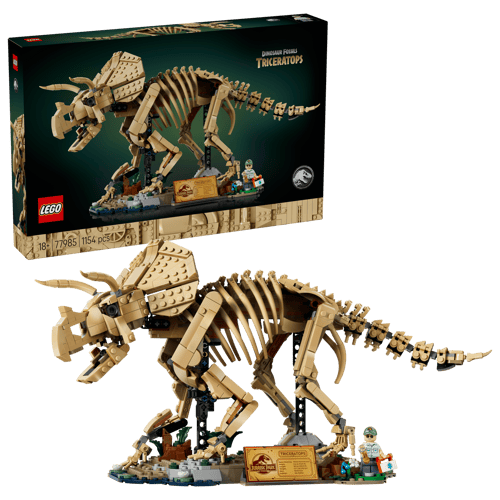
For a more authentic paleontological experience, I considered dumping the contents of each bag into a bin full of tan bricks. Sense got the better of me, and instead I enlisted the aid of my resident dinosaur expert (my 14-year-old son) to help me with the review.
New mould
- 10x Animal Body Part / Plant, Tail / Claw / Horn / Branch / Tentacle, Long End Section [rib] in Tan (6610339 | 8254)
This new part is a longer brother of the existing Animal Body Part / Plant, Tail / Claw / Horn / Branch / Tentacle, End Section (
40379). Pleasingly, the new part follows the same curvature.
The tip is a standard bar attachment that follows a fixed diameter for half a
module, up to a slightly thicker lip. This is unlike its predecessor, which has a tip that tapers smoothly out towards the thicker end from the thinner, 3.18mm diameter bar.
It spans an area of approximately 5x6 modules including the half-module bar protrusions for attachment. It's clear that, like part 40379, the angle at the tip is not square; it appears to be set at an angle of around 13.5°.
Extending the new rib part with other existing tentacle-like parts (such as
67361 and
51274 shown above) should offer some very pleasing opportunities.
How long before an Instagram post will "Release the Kraken!"? or are these pieces destined for Davy Jones' beard? A three-toed sloth? Or maybe simply a mammoth's tusk?
Recoloured pieces
- 2x Animal Body Part, Fin 2 x 4 with Handle in Tan (6617745 | 7511)
- 2x Slope 30° 1 x 4 x 2/3 in Tan (6617744 | 7835) - it's nice to see long cheese appearing in other colours, also available in black, light bluish gray, dark bluish gray and red.
- 4x Plate 3 x 3 Corner in Tan (6596674 | 77844)
- 1x Plate 2 x 3 with 1 x 1 Cutout in Tan (6617742 | 73831)
- 4x Plate Special 1 x 2 with Angled Handles on Side in Tan (6621008 | 92692)
- 31x Plate Special 1 x 1 Rounded with Handle in Tan (6603737 | 26047)
- 11x Bar 1L with Clip [Cut Edges and One Side Hole] [Full Clip] in Tan (6617768 | 3484)
- 2x Plate Round 1 x 1 with Solid Stud in Light Nougat (6607891 | 6141)
- 4x Plate Special Round 2 x 2 with Center Stud (Jumper Plate) in Sand Green (6610100 | 18674)
Astonishingly, the robot arm hasn't come in tan in the previous variants of this mould either.
I was also slightly surprised by the 1x1 round having not appeared in light nougat before. It seems to have occurred only because of the choice of using a rarer colour of the peony (see below) in this model. Incidentally, the hollow stud variant (
85861, 28626) is available in light nougat already!
Rare & reintroduced
Here are the pieces that haven't appeared in many sets, or are returning after a long period of absence.
- 1x Technic Bush 1/2 Smooth with Axle Hole Semi-Reduced in Black
(6600750 | 32123b, 42136) – found in four other sets
- 2x Brick Round 1 x 1 D. Tube with 45° Elbow and Axle Holes (Crossholes) at Each End in Tan (6550259 | 7324) just four were previously available in 10348 Japanese Red Maple Bonsai Tree; see Ben's review
- 2x Wedge Plate 6 x 4 Left in Tan (6617752 | 48208) only previously available in 41716 Stephanie’s Sailing Adventure from 2022
- 2x Wedge Plate 6 x 4 Right in Tan (6617740 | 48205) also only in 41716 Stephanie’s Sailing Adventure from 2022
The LEGO Technic half-bush was reintroduced in black this year, appearing in three other sets so far, but its return is a pretty big deal because, prior to 2026, it has not been seen in black since its first-ever appearance in set
7019 Viking Fortress against the Fafnir Dragon... 21 years ago!
Moving on now to the pieces appearing in two other sets:
- 2x Brick Curved 2 x 2 with Curved Front, 2 Studs in Tan
(6525418 | 7037)
- 3x Tile 1 x 2 with Stud Notch Right in Dark Tan
(6528180 | 5092)
- 1x Plant, Flower, Peony Rose with 2 Layers in Light Nougat
(6554611 | 5904)
I was curious as to why light nougat was picked for the peony. As mentioned, it presumably is what necessitated the 1x1 round plate to be recoloured to match… so why pick the rarer flower colour?
Here are the pieces in three other sets:
- 1x Brick Special 1 x 1 x 1 2/3 with 6 Studs on 3 Sides in Black
(6602161 | 7729)
- 2x Plate Round Corner 2 x 2 in Dark Blue
(6587921 | 7904)
- 1x Slope Curved 2 x 2 with Stud Notch Left in Tan
(6546722 | 5095)
- 1x Slope Curved 2 x 2 with Stud Notch Right in Tan
(6546719 | 5093)
Other parts of note
- 2x Wheel Arch, Mudguard, 1 1/2 x 6 x 1 [Arch Extended] in Tan
(6530045 | 62361, 4925, 63970) – in four other sets
- 32x Plate Special 1 x 2 Rounded with 2 Open Studs in Tan (6212758 | 35480) – a decent quantity, but not the highest in a set
The wheel arch was introduced in tan in 2025 and this is the fifth set to include it, but I mention it as it feels like a key piece for those of us who've been wanting to recolour the original LEGO® Ideas
21320 Dinosaur Fossils to tan. Although, I'm still waiting for some bent Technic beams (
42149, 6629) to be recoloured!
Printed part
- 1x Tile 4 x 8 with print in Reddish Brown (6629694 | 8165)
Minifigure of Dr. Gerry Harding
- 1x Hat / Cap Short Curved Bill with Seams on Peak and Button on Top with Jurassic Park Logo print in Sand Green (6600509 | 93219, 11303)
- 1x Minifig Head with Sunglasses and Moustache print in Light Nougat (6600507)
- 1x Torso with Pockets and Jurassic Park print in Light Aqua (6619504)
- 1x Legs with belt and ID tag print in Sand Blue (6618516)
Dr. Harding has a small role in the 1993 Jurassic Park, mostly treating a sick Triceratops alongside Ellie Satler. The film version of his InGen uniform appears to me to be more green-hued overall, but allowing for the existing LEGO colour palette, this is a pretty good representation of what he wears.
The build
Firstly, Gerry gets a neat little vignette to accompany the now-obligatory description plaque.
Blue cherries will give you a bad tummy – or, more accurately, West Indian Lilac, as I assume these are intended to represent the berries from the film. They weren't the cause of the illness of the Triceratops in the film, but they were in the book, inadvertently.
"We know they're toxic, but the animals don't eat 'em."
"Are you sure?"
"Pretty sure."
Appropriately, the cherries can be found in this model in "one big pile of s***!"
The display stand follows; this is a neatly repeated sub-assembly. A tree stump at the front of the stand contains an appropriate, if slightly predictable 'mosquito trapped in amber' Easter egg.
It's here also that the arguably unnecessary recolour of the light nougat 1x1 round plate is employed, as a result of the choice of colour for the peony. I can agree with the aesthetic ideal of not wanting to draw the eye away from the skeleton with brighter colours. I still have to ask if there could have been a suitable alternative amongst the existing options? The flower is also somewhat hidden, and so my speculation is that the light-nougat 1x1 round plate will appear in a more necessary role in an upcoming set.
Two LEGO Technic beams provide all the support for the spine, which is mostly built from plates and brackets. Everything else will be built off of these three main connected structures!
The back section neatly coincides with a fused section of the spine known as the sacrum. The new fin part (
7511) ably mimics the central part of the hip bone, a.k.a. the pubis.
All 32 of those tan 1x2 rounded plates (
35280) get used in a single step. They provide the attachment points for the ribs, and are the only truly repetitive part of the build.
The new rib element (8254) really works well here, augmented by candlesticks and the existing smaller rib element (
40379). This creates a fairly faithful looking rib cage.
The front legs and shoulder blades are actually attached to the front Technic beam with Mixels ball joints, but do look as though there is some magical joining interface with the rest of the skeleton holding them in place.
Similarly, the back legs are attached to the back Technic beam and the hip bones (or ilium) are neatly secured to the spine, again using Mixels ball joints. At the back, the Triceratops' hip also features details such as an ischium, which is simply but effectively constructed with two more of the original rib sections.
More Mixels joints are at the centre of the tail, and this completes the body.
Finally, the head is constructed, mostly employing commonplace sideways building and SNOT techniques. There’s a frog in his throat, or has the cat got his tongue?
I have another question about the choice of recolours here too: why not reintroduce the frog in tan instead of the 1x1 round plate in light nougat? The frog was recoloured in tan for 80102 Dragon Dance back in 2019. It's possible that I'm missing another Easter egg here, but I'm guessing that this is simply
another reference to the frog DNA that's fairly central to the plot of
Jurassic Park.
Black Panther's head-top with ears (
25264) is used to create the eye-socket. Mounting that ring-shaped piece via a 1x1 round plate onto a "D-SNOT" brick (
3386) enables it to be angled.
The head looks a little unusual when it's attached to the body without the frill, but that is going to be resolved quickly.
Some neat reflected symmetry is employed here to create curvature or "radius". Click joints are used to form that construction into the shield-like shape of the frill.
Adding the frill completes the head of the Triceratops and I think the two sections of the skull interface very well.
No new or particularly innovative techniques have been used in the build but nothing felt overly familiar either. It's a surprisingly fun build, with only one section really requiring repetition.
Most of it is pretty solidly built. However, it's not really for playing with; this is a display model, and I was reminded of that every time I moved the model for a photograph. There are a few fiddly bits that get knocked easily. The ribs and feet are particularly temperamental but I feel the poseability is definitely worth sacrificing some stability to achieve.
Value and other thoughts
- Price: £89.99 ($109.99 / €99.99 / AU$149.99)
- Price per gram (PPG): 1180g = 7.63p
- Price per piece (PPP): 1254 pieces = 7.18p
Comparatively speaking, based on weight, this feels like a reasonable price (in the UK at least).
A commodity value based on the PPG of sets I have reviewed over the last few months would suggest that below 6p per gram is very good, around 7p to 8p would be reasonable and anything much above 10p is pretty poor value.
- Price: £119.99 ($129.99 / €129.99 / AU$199.99)
- PPG: 1368g = 8.77p
- PPP: 1297 pieces = 9.25p
- Price: £99.99/ ($99.99/ 109.99€/ AU$179.99)
- PPG: 1038.5g = 9.63p
- PPP: 830 pieces = 12p
* Perhaps contentiously, I'm not counting a brick-built character as a minifigure here.
The LEGO Triceratops Fossil feels like pretty good value in those head to heads.
- Price: £219.99 ($249.99 / €249.99 / AU$399.99)
- PPG: 3872g = 5.68p
- PPP: 3145 pieces = 6.99p
That seems pretty amazing value in comparison to be honest, but then much larger sets have economies of scale. They mostly suffer from a high cost outlay that won't be in everyone's budget.

In the real world, Triceratops is a smaller animal than a T-rex, but this set feels disproportionately smaller when compared to that totally terrific Tyrannosaurus rex fossil.
Triceratops were approximately 8 to 9 metres (26 to 30 feet) while
Tyrannosaurus were around 12 to 13 m (39 to 43’), so roughly about three-quarters of the length.
According to
its LEGO product page, the 76968 T. rex measures 105 x 33 cm. Unusually, the product page for the Triceratops ain't braggin’ about the size of this model, so I had to take measurements myself: 45 x 21 cm, which is a bit under half the length of the T-rex. I think it's fair to conclude that these definitely aren't intended to be at the same scale.
I wonder whether it was thought that mentioning the dimensions of the Triceratops might translate as a negatively perceived value based on what came before?
It's also just about a third of the pieces: 1154 for this frilled herbivore versus 3145 in the big old carnivore! What would a Triceratops in scale with its predecessor and maybe closer to 2400 parts have looked like? Could it have been better?
I don't believe an increase in parts (and therefore price) would have made all that much difference. I feel scale is not so much of an issue when the set does its job this well. Furthermore, I think this makes subsequent skeletons at a similarly reduced scale all the more likely – which I would be happy to see, as the fossil range has included some of the highlights of the last couple of years, for me. This set also has the undeniable appeal of a price that just feels more affordable – rather than just being for those very special occasions.
I also feel that the smaller Triceratops model is more easily moved about, on account of being less unwieldy.
I think this looks like a pretty good representation of a Triceratops at the chosen scale but how accurate is it?
Let's look at the real thing.
The Big John Triceratops skeleton, on display at the Drouot auction house in Paris ©Eviatar Bach
via Wikipedia
'Horridus', the most complete Triceratops fossil known, on display at the Melbourne Museum. ©Ginkgoales
via WikipediaI found this neat annotated skeleton reconstruction on
SV-POW; the original, un-annotated drawing is attributed to
O. C. Marsh (1891). My son says this is pretty out of date with modern thinking, but I argued it still shows key features of the skeletal structure.
The forms aren't exact in the model, but the broad bones of the legs, hips and shoulders are contrasted by the more delicate bones of the ribs and spine.
From the reconstruction drawing and reference images above, it is clear that some considerable care and attention has been paid to replicating many details, for example: the ulna and radius in the front legs, the tibia and fibula in the back legs, the dorsal vertebrae and the scapula.
The tail could probably have depicted more caudal vertebrae, and perhaps more finesse was possible in the head but overall I think the skeleton looks excellent and don't feel anyone could expect much more. There might be inaccuracies at this scale, but I think there were a similar level of inaccuracies with 76968 T. rex too, even at the larger scale and price point.
I certainly think there have been enormous improvements made in comparison to the "Trike" found in
LEGO Ideas set 21320 Dinosaur Fossils that was reviewed by Elspeth all the way back in November 2019!

The newer Trike fossil is substantially bigger and it is probably fair to expect improvements because of that size. Furthermore, the development of new parts in the time since the LEGO Ideas set was released should mean an improvement in accuracy in these sorts of builds too. I've shown the old fossil model here along with my son's original moulded Triceratops from 5885 Triceratops Trapper to help give a sense of these improvements and the size difference.
My son was also kind enough to lend me his
76969 Dinosaur Fossils: Triceratops Skull for this review as a further comparison. He noticed that the ball joint (
57909b) found at the back of the skull fossil is the same as the one used in the skeleton and suggested this hilarious hybrid:

After my initial amusement passed I saw what might arguably constitute a comparison to a proportionally larger headed juvenile triceratops. That further increased the appeal of the set for me, bringing added display opportunities!
On the subject of display, the minifigure and plaque portion of the build can be attached either side of the stand (by virtue of that first repeated sub assembly). This allows the Triceratops to face in your preferred direction.
The limited colour palette and subject matter means that there are a lot of tan parts here; it looks a little more coherent than the big T. rex in that respect. Usually that kind of limit indicates we might have a candidate for a good parts pack, but can a £90 set ever be a good parts pack? In my mind I want a parts pack to be under £30, and even better if that's because it's on offer.
The Triceratops does contain a few multiples and some of those in what might be considered as higher quantities. The list of tan parts with a quantity of 10x and above is pretty impressive:
- 32x Plate Special 1 x 2 Rounded with 2 Open Studs (6212758 | 35480) - as mentioned above
- 31x Plate Special 1 x 1 Rounded with Handle (6603737 | 26047) - as mentioned above
- 22x Tile Round 1 x 1 Half Circle (6353196 | 24246, 35399)
- 20x Slope 30° 1 x 1 x ⅔ (4516055, 4278069 | 54200)
- 19x Bar Holder with Hole and Bar Handle (6458391 | 23443, 49755)
- 17x Plate 1 x 1 (4159553, 302405 | 3024)
- 16x Slope Curver 2 x 1 No Studs [1/2 Bow] (6046922 | 11477)
- 14x Plate Round 2 x 2 with Rounded Bottom (Boat Stud) (4140561 | 2654)
- 14x Plate Special 1 x 2 with 1 Stud and Inside Stud Holder (Jumper) (6092587 | 15573)
- 13x Brick Curved, 3 x 1 with 1/3 Inverted Cutout (6328182 | 70681)
- 12x Tile Special 1 x 1 with Clip with Rounded Edges (6252969 | 15712, 44842)
- 11x Bar 1L with Clip (6617768 | 3484)
- 11x Plate 1 x 2 (4113917, 302305 | 3023)
- 10x Animal Body Part / Tentacle, Long End Section [Rib] in Tan (6610339 | 8254) - as mentioned above
- 10x Technic Brick 1 x 1 with Pin Hole (4179771, 654105 | 6541)
- 10x Equipment Candlestick (6454936 | 37762)
- 10x Bar 2L with Stop in Center (6447501 | 78258)
The total cost of those 262 parts at Pick a Brick would be £16.71 + postage (this is omitting 10x the new larger rib). Allowing for an inflated cost on those too, when they eventually appear on PaB, perhaps that goes some way to justifying that this set could be considered a parts pack after all? Because this is not an exhaustive list of all the interesting, newer or even general parts found in tan, and obviously there are more besides.
The set is aimed at adults. I think it's fair to say that the build is not challenging enough to require a 18+ age mark, as my 14-year-old son did the majority of this build and was more than capable. I don't especially see the subject matter as being more adult-oriented either; dinosaurs are popular across all age groups and I think marketing this product solely to adults does consumers a disservice. I'm going to assert (
as I have before) that I don't think anyone should need a black box to feel okay about buying LEGO products.
A handful of LEGO Jurassic World sets are slated for release in August, and I really hope they are not the last, as there are still plenty of dinosaurs to depict in LEGO form. Whether moulded or brick-built, full-bodied or skeletal interpretations would all be welcome in my house. Some love for Parasaurolophus would please me most, although fossil versions of Stegosaurus or any of the larger sauropods could easily find their way onto my son's shelves! I'm told that this Triceratops Fossil is now his, in any case.
Which dinosaur/s and in what format would you like to see introduced next? Let us know what species you need in your collection in the comments.
Conclusion
My son and I really like Triceratops, it's one of our favourite dinosaurs. So our enthusiasm may be positively impacting my final judgement a little – but this set has also ticked some key boxes for me: It is good value for the quantity of LEGO bricks, contains a reasonable number of new and recoloured parts – not least, ten of the new rib to play with, and the build itself was varied and sufficiently challenging enough to be diverting.
Triceratops are one of the most recognisable and widely appreciated dinosaurs, a popular exhibit that has been translated very well into LEGO form. This set is the Tricera-TOPS! I'm sure it will be a great addition to any collection.
Besides, what else could you buy with £90 that scratches your prehistoric itch so well? Certainly not the real thing; back in March a Triceratops fossil discovered in 1993, known as “Trey”,
sold for US$5.5 million, on
Joopiter. So it is definitely cheaper to own the LEGO version, and much less contentious to invest in it for your own private collection (I’m with Indiana Jones on this type of thing).
I'm giving this set a recommendation: it does a great job of depicting the Triceratops, it was an enjoyable build, beats paying $5.5 million, and will go fantastically with the other LEGO dinosaur fossils you (probably) already own. I hesitate to suggest a day-one purchase if there's no gift with purchase, but I definitely think it's a good value set that wouldn't require much more incentive for me to buy.
As this one has been commandeered by my son, I guess that's another recommendation and I'll just have to buy my own!
READ MORE: Review of the gorgeous new LEGO® Chinese Festivals set 80121 Ancient Moon-Gazing Inn
Help New Elementary keep publishing articles like this. Become a Patron!
A huge thank you to all our patrons for your support, especially our 'Vibrant Coral' tier: London AFOLs, Antonio Serra, Beyond the Brick,
Huw Millington, Dave Schefcik, David and Breda Fennell, Gerald Lasser, Baixo LMmodels, Sue Ann Barber and Trevor Clark, Markus Rollbühler, Elspeth De Montes, Megan Lum, Andy Price, Chuck Hagenbuch, Jf, Wayne R. Tyler, Daniel Church, Lukas Kurth (StoneWars), Timo Luehnen, Chris Wight, Jonathan Breidert, Brick Owl, BrickCats, Erin and Dale, Jake Forbes, H.Y. Leung and our newest top-tier patron, Keith Marcelletti! You folks are better than inverted cheese slopes.
All text and images are ©2026 New Elementary unless otherwise attributed.


loved the extra thoughts and the headswap but would have preferred a wider angle for both t-rex and tritops in one image for better comparison. But tbh one can already see the scaling difficulties you mentioned :)
ReplyDeleteI did want to show more of the two skeletons together but that's entirely the problem! They were too big to fit on the backdrop I was using!
DeleteUseful review, thank you. Opinion: how strange for TLG to include a fictional character in his very nice model instead of taking the opportunity to recognize an actual scientist.
ReplyDeleteProbably because this is being released within the Jurassic World theme. I agree though, recognising real scientists would be better.
DeleteA tan frog would've been a nice inclusion. Definitely meant to be an easter egg, though. The T-Rex unfortunately completely hides its frog during the build process, whereas this one feels a bit blatant by just sticking it in the mouth.
ReplyDeleteFrom one extreme to another!?
DeleteI'm kind of happy the black 1/2 bushing isn't going to cost like $30 on BL anymore. Such a stupid piece to not have in black. I needed a bunch for a build and just went with good old Aliexpress knockoffs instead
ReplyDeleteA really welcome reintroduction!
DeleteMore tan yes! The new angles and the 1x4 cheese slope and the padlock plate all great for architecture. Nice bevelled columns here we come.. Can't wait for these to be available on PaB
ReplyDeleteSome really nice additions!
DeleteI don't understand why this needs a Jurassic World stamp... Besides the minifig it has not concrete relation to the franchise and could just have been an icons set, lowering the price significantly as royalty did come on top.
ReplyDeleteI'm guessing because they established the fossils as being part of the Jurassic theme. I'd prefer them to be a part of a 'Natural History' theme!
DeleteI agree about the additional cost added by the license, but it's worth pointing out that the set is already pretty good value (comparatively).
Oh my gosh just last night I was lamenting that the bar with clip piece didn’t come in tan. I guess my Bane will have fingerless gloves after all :D
ReplyDeleteYour Bane is no longer a bane, but confusingly and ironically more of a Bane!?
DeleteNice review!
ReplyDeleteI'm glad that the longer rib piece has a more specific cutoff between the 3.2mm end and the tapered middle. I always kind of worry when attaching parts with clips or hollow studs to the shorter version that I might accidentally damage it, especially since the plastic seems softer than usual Lego and it'd be easy to push a part "too far" on.
Those other tan recolors are very nice as well, the 3x3 corner plate and 2x3 "U" plate are both nice basic parts that can be useful architecturally, so it's great to have them in a versatile color like tan.
Thanks! Yes I agree, it's great to have those parts in tan - useful elements that I can't quite believe weren't already in the mix!
Delete